There's a pattern in tech where the most important infrastructure is the most boring to talk about. RSS is a perfect example. For two decades, it quietly powered how the internet distributed content — until feed readers died and the algorithm took over. Most people didn't notice until they missed it.
MCP feels like that same quiet infrastructure moment — except this time, for AI.
What MCP Actually Is
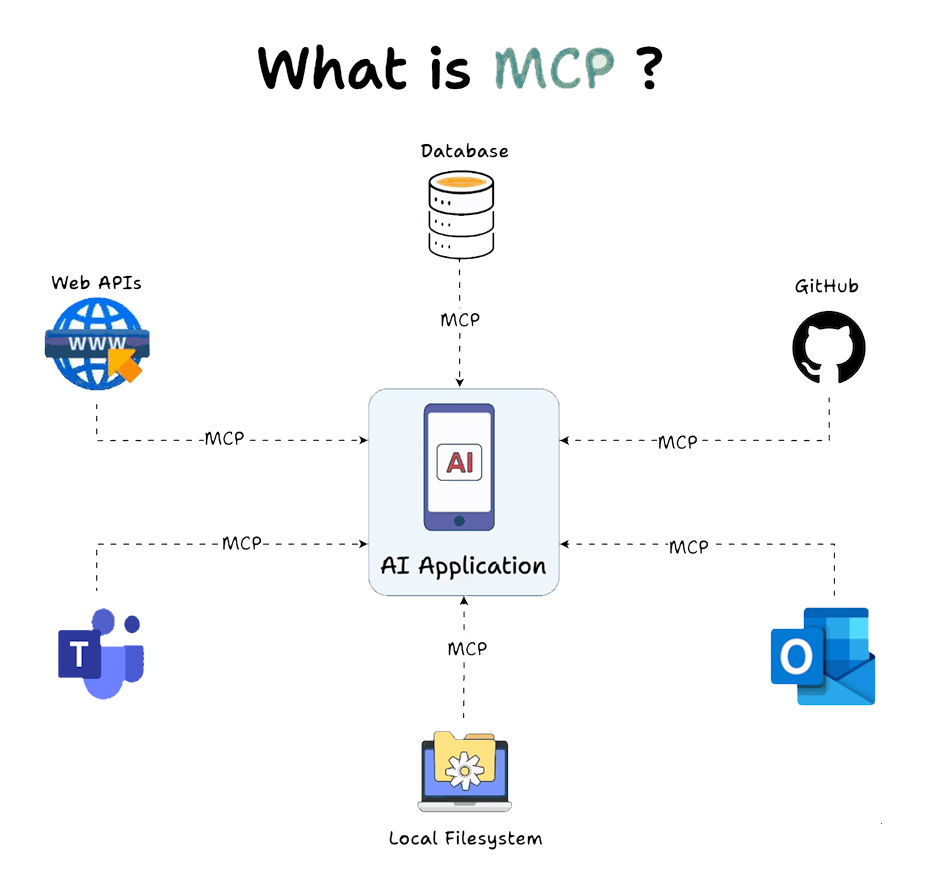
At its core, MCP (Model Context Protocol) is a standardized way for AI agents to connect to external tools and data sources.
Instead of every LLM integration being a one-off API hack, MCP gives you a common interface:
Here's what I can do
Here's how to call it
Here's what you'll get back
It's a handshake protocol — nothing more, nothing less. Anthropic open-sourced it in late 2024, and since then adoption has been surprisingly steep. Tools like Claude, Cursor, and Zed have all added native support. It's starting to feel less like an Anthropic experiment and more like a genuine open standard.
The RSS Parallel Is Not a Stretch
RSS solved a specific problem:
How does a feed reader know what's new on a blog — without scraping raw HTML?
It didn't reinvent content. It just wrapped it in a predictable envelope.
MCP solves the same class of problem for agents:
How does an AI assistant know what tools it has, what data it can read, what actions it can take — without hardcoded integrations for every service?
You expose an MCP server. The agent figures out the rest.
RSS
MCP
For
Feed readers
AI agents
Solves
Content discovery
Tool/data discovery
Design
Boring by intent
Boring by intent
Power
Universal parsing
Universal interfacing
Both protocols are boring by design. Both are powerful because of that boredom.
Why This Matters for the Open Web
The web's current AI moment is largely closed. Most LLM integrations live inside walled gardens:
ChatGPT plugins
Claude.ai connectors
Proprietary RAG pipelines
Data flows in, but never back out in any standardized way.
MCP changes the incentive structure. If you run a blog, a docs site, or a database — you can expose an MCP feed and suddenly every MCP-compatible agent can interact with your content natively. You're not waiting for OpenAI to add a plugin for you. You're publishing a standard interface and letting agents discover you.
That's exactly what the open web did with RSS. And it's exactly what's been missing from the AI content layer.
NowBind Is Betting on This
This blog runs on NowBind — a platform built with MCP feed support baked in from day one. Every post here is automatically available as an MCP-readable feed. Not as a gimmick, but because this is the direction the content web is heading.
If AI agents are going to read the internet, the internet should be readable. MCP is how that happens.
We're early. The tooling is rough, the spec is still evolving, and most developers haven't heard of it yet. But the same was true of RSS in 2001. And we know how important that turned out to be.