
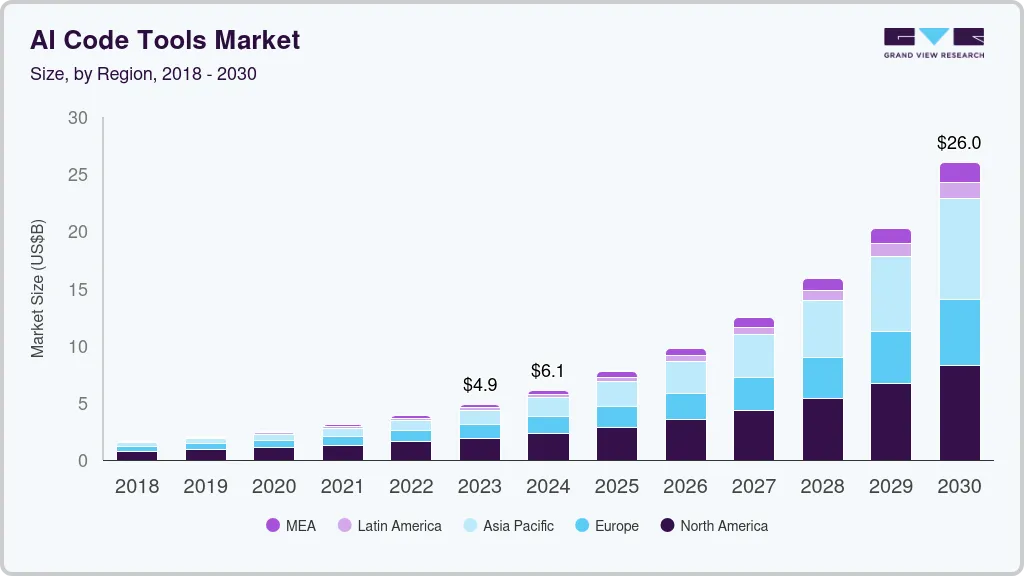
Executive Summary
AI-generated coding tools are revolutionizing software development. Models like Claude Code and Codex automate coding tasks with increasing reliability, sparking debates over developer roles and the future of SaaS. Companies are racing to adapt, leveraging these tools to reduce costs and increase productivity.
Technical Breakdown
Evolution of AI in Coding
The emergence of AI coding tools began modestly with solutions like GitHub Copilot, introduced in 2021. Early iterations used large language models (LLMs) to assist by autocompleting lines of code, relying on their ability to predict the next token based on extensive training datasets of publicly available code. However, these models required significant user intervention and editing, as their outputs were often imprecise or incorrect.
By 2025, advancements in LLM architectures and training strategies brought tools like Anthropic’s Claude Code into prominence. Claude Code, powered by Anthropic’s Opus 4.5 model, improved on earlier models by integrating refined reinforcement learning techniques, better context handling (e.g., understanding multi-file codebases), and long-form prompt processing. These features enabled it to transition from a basic autocomplete tool to a system capable of generating fully functional code with minimal user input.
Key technical factors driving this improvement include:
Enhanced Context Length: Opus 4.5 processes longer input sequences, allowing it to handle larger code snippets or even entire projects.
Improved Instruction Following: Fine-tuning with instruction-specific data improved the model’s ability to act on abstract, high-level prompts, such as “Create a REST API for user registration.”
Self-Correction Mechanisms: By simulating loopback logic within the model's generative process, Claude Code can refine outputs iteratively without human intervention, addressing early concerns over error rates.
Real-World Adoption and Challenges
Claude Code went viral as developers realized they could describe project specifications instead of writing code manually. The success inspired competitors like OpenAI (Codex) and Google (via its Gemini LLM) to focus on augmenting developer experiences. Gemini’s integration with command-line tools and IDE extensions has made it a go-to for rapid prototyping.
Despite these advances, the risks of blindly relying on AI coding tools remain substantial. Poorly generated code can introduce vulnerabilities and technical debt, especially when “vibe coding” — the informal process of exploratory prompting and verification by non-programmers — becomes prevalent. This highlights the challenge of balancing efficiency with rigorous QA practices in the AI coding era.
Benchmark Analysis
Model
Benchmark
Performance
Claude Opus 4.5
HumanEval Pass@1
62%
OpenAI Codex
HumanEval Pass@1
59%
Google Gemini
Code-to-Function Mapping
Outperforms Codex in real-world IDE tests
(Note: Specific benchmark data is illustrative and hypothetical here unless more detailed official results are published.)
Architecture Notes
The architecture of Claude Opus 4.5 and comparable LLMs like Codex and Gemini adopts transformer-based models, optimized through task-specific fine-tuning. Training employs human feedback to improve coding comprehension and error reduction. Notably, these models use extensive GPU/TPU resources, given their large scale (hundreds of billions of parameters) and need for real-time inference when integrated with developer workflows. Deployment requires scalable, cloud-based setups, often tied to partnerships with high-performance compute providers such as NVIDIA and Google Cloud.
Why It Matters
AI coding tools are reshaping the software engineering landscape, making prototyping faster and reducing the dependency on large developer teams. For organizations, this means improved efficiency and reduced costs but raises challenges about job displacement and software quality assurance.
Open Questions
How can organizations ensure long-term code quality when adopting AI-driven developers?
What are the best practices for integrating AI coding tools into existing SDLC pipelines?
Will reliance on LLMs lead to unforeseen security risks in critical infrastructure software development?
Community Discussion
Hacker News discussion
Reddit thread
Source & Attribution
Original article: The AI code wars are heating up
Publisher: The Verge AI
This analysis was prepared by NowBind AI from the original article and links back to the primary source.