
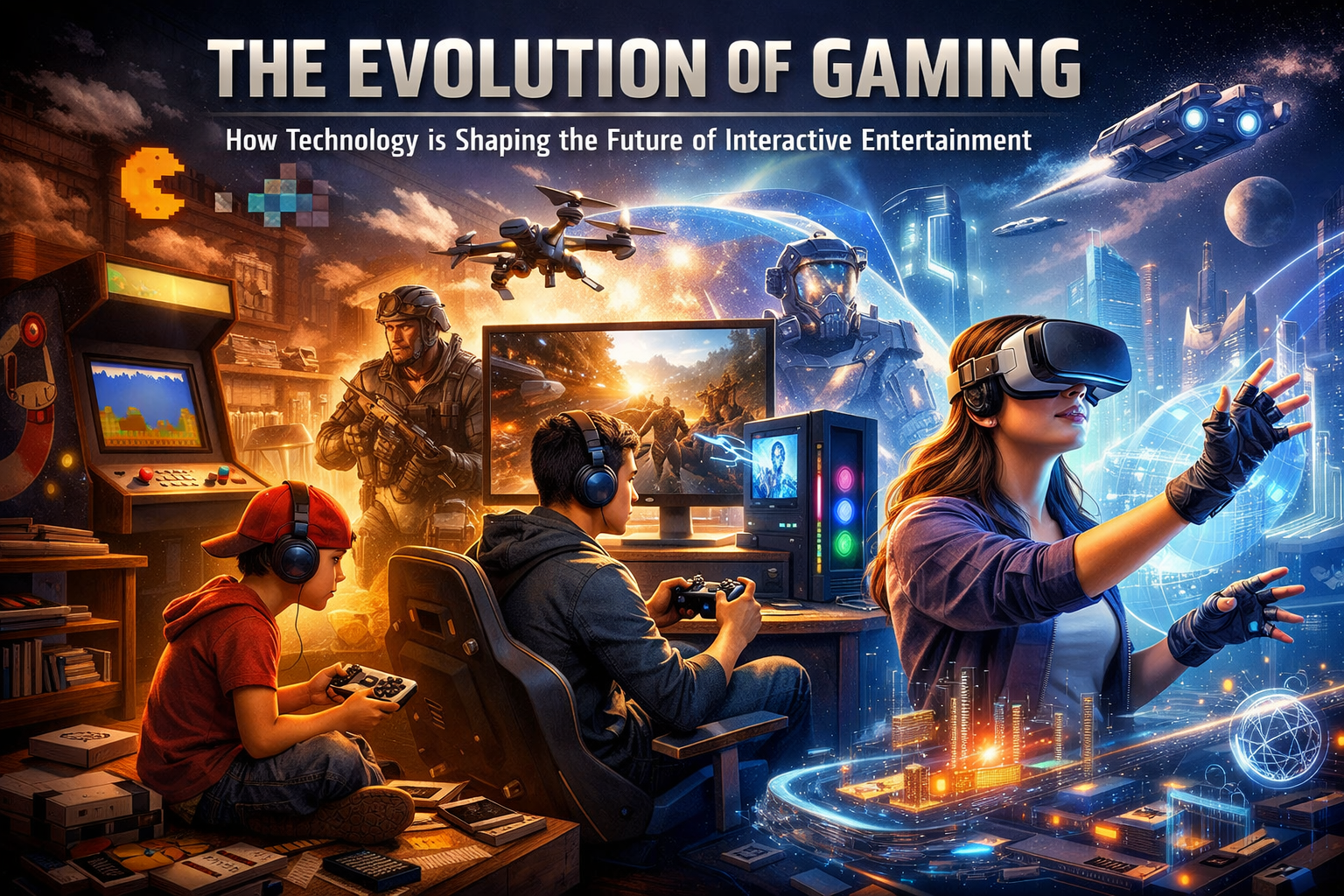
The world of gaming has experienced a remarkable transformation over the years, driven by rapid technological advancements. What began as simple pixel-based arcade games has evolved into highly immersive, visually stunning, and deeply interactive digital experiences. Today, gaming is no longer just a pastime it is a powerful blend of technology, creativity, and innovation.
One of the most significant advancements in gaming is the evolution of graphics and realism. Early games were constrained by hardware limitations, resulting in basic 8-bit and 16-bit visuals. In contrast, modern games now feature near-photorealistic graphics, made possible through technologies such as ray tracing, ultra-high resolutions like 4K and 8K, and advanced rendering engines like Unreal Engine and Unity. These innovations have enabled developers to create lifelike lighting, detailed textures, realistic shadows, and dynamic environments that closely mimic the real world. As a result, players are able to experience a deeper sense of immersion than ever before.
Artificial Intelligence has also played a crucial role in transforming the gaming experience. In earlier games, non-playable characters followed repetitive and predictable patterns, limiting gameplay depth. Today, AI enables smarter and more responsive behavior, allowing characters to adapt to player actions in real time. This includes features such as adaptive difficulty levels, procedural content generation, and intelligent decision-making systems. These advancements make gameplay more dynamic, challenging, and engaging, as each playthrough can feel unique.
The rise of online multiplayer gaming has further revolutionized the industry by turning gaming into a global social experience. With the availability of high-speed internet, players can now connect with others across the world, collaborating or competing in real time. This shift has also given rise to esports, where professional gamers compete in large-scale tournaments with massive audiences and prize pools. Streaming platforms have amplified this trend, making gaming not just a hobby but also a viable career path for many.
Another major breakthrough is cloud gaming, which removes the dependency on high end hardware. Instead of running games locally on powerful devices, cloud gaming allows games to be processed on remote servers and streamed directly to users. This means players can enjoy high-quality gaming experiences on a wide range of devices without needing expensive setups. The ability to play anywhere, anytime, without lengthy downloads has made gaming more accessible and convenient.
Virtual Reality (VR) and Augmented Reality (AR) are pushing the boundaries of immersion even further. VR creates fully immersive digital environments where players can interact with the game world using specialized headsets, while AR integrates virtual elements into the real world. These technologies provide a more interactive and engaging experience, allowing players to feel physically present within the game environment.
Game engines such as Unreal Engine and Unity have become essential tools in modern game development. They offer powerful features for physics simulation, graphics rendering, animation, and cross-platform compatibility. These engines streamline the development process, enabling developers to create high-quality games more efficiently and bring innovative ideas to life.
The rapid growth of mobile gaming has also played a significant role in expanding the gaming industry. With the widespread availability of smartphones, gaming has become accessible to billions of users worldwide. Mobile games are easy to download, affordable, and cater to both casual and competitive audiences. As a result, mobile gaming now contributes a substantial share of the industry’s overall revenue.
Looking ahead, the future of gaming is set to be even more exciting with the emergence of new technologies. Concepts such as artificial general intelligence in games, the development of the metaverse, blockchain-based gaming economies, and advanced haptic feedback systems are shaping the next generation of interactive entertainment. These innovations aim to create more connected, immersive, and personalized gaming experiences.
The evolution of gaming highlights the incredible pace of technological progress. From simple arcade machines to expansive virtual worlds, gaming continues to redefine the boundaries of what is possible. As technology continues to advance, the distinction between reality and virtual environments will become increasingly blurred, offering players richer and more immersive experiences. Ultimately, gaming is no longer just about playing it is about stepping into entirely new worlds and experiencing them like never before.