
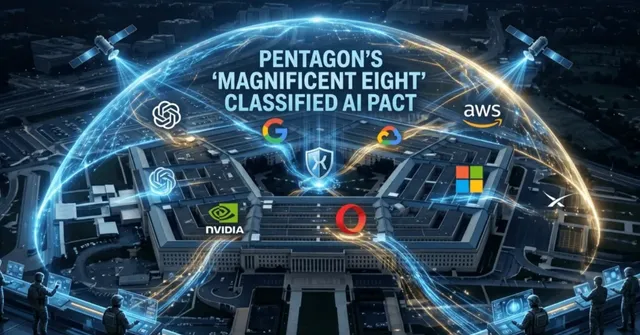
The U.S. Defense Department has announced major partnerships with Nvidia, Microsoft, Amazon Web Services (AWS), and Reflection AI to bring advanced artificial intelligence capabilities to classified military networks. This bold move positions the Pentagon as an 'AI-first' force and reflects its determination to build a resilient, vendor-diverse AI ecosystem in an era of escalating digital competition. These agreements allow the deployment of cutting-edge AI models and infrastructure on classified networks designated Impact Level 6 (IL6) and Impact Level 7 (IL7), the highest tiers of national security data systems.
The Pentagon’s announcement emphasized the transformative implications of these partnerships. “These agreements accelerate the transformation toward establishing the United States military as an AI-first fighting force,” the DOD stated. “Access to a diverse suite of AI capabilities... will give warfighters the tools they need to act with confidence and safeguard the nation.”
This announcement comes as the DOD works to diversify its AI vendor pool following a contentious legal dispute with Anthropic, a prominent AI research lab. The controversy underscores the strategic importance—and geopolitical sensitivities—of artificial intelligence within national defense.
DOD Deepens AI Integration with IL6 and IL7 Environments
The new agreements will allow AI technologies to operate within the secured confines of IL6 and IL7 environments. These classifications signify the Pentagon’s most secure networks, where national security and mission-critical systems interact. While the specifics of implementation remain classified, the DOD hinted at applications spanning "data synthesis, situational awareness, and decision-making augmentation."
IL6 and IL7 environments are paramount for safeguarding sensitive information. IL6 systems, for instance, are secured against external threats and physically restricted to authorized personnel. IL7 classifications, introduced more recently, apply to hypersensitive systems integral to operational warfare and require even greater protections. By incorporating Nvidia’s GPUs, Microsoft’s Azure cloud platform, and AWS’s expertise, the Pentagon will gain the computational muscle necessary to run data-intensive AI processes securely.
This secure framework is also a prerequisite for the DOD’s GenAI.mil platform, an enterprise AI solution reportedly already in use by over 1.3 million personnel. While GenAI.mil is leveraged primarily for lower-stakes, non-classified tasks like document drafting and data analysis, the integration of Nvidia, AWS, and Reflection AI opens the door for deploying these capabilities in far more critical tactical operations.
Vendor Lock-In Concerns Take Center Stage
The Pentagon’s strained relationship with Anthropic underscores why vendor lock-in is now a key consideration in its AI strategy. Anthropic, founded by former OpenAI researchers, sued the DOD after the military demanded unrestricted use of its AI tools. Anthropic was particularly alarmed by potential military deployments of its technology for mass surveillance or autonomous weapons. The resulting legal impasse, which escalated into a U.S. court injunction, sparked fresh debate on ethical AI use within defense systems.
To avoid repeats of such disputes, the DOD is systematically broadening its supplier base. “The Department will continue to build an architecture that prevents AI vendor lock-in and ensures long-term flexibility for the Joint Force,” its statement read. By engaging a range of vendors, the Pentagon reduces dependency on any single technology provider, ensuring flexibility both technologically and contractually.
The competitive tension is not limited to Anthropic’s legal case. Industry dynamics reveal that moves by cloud and AI giants like Microsoft and Amazon are creating a high-stakes battlefield for Pentagon contracts. Years after Microsoft’s JEDI contract win was overturned in court amid lobbying from Amazon, a more modular approach could reduce legal and political risks for the DOD. By including Nvidia, a chipmaker with no cloud ambitions, the Pentagon rebalances its vendor portfolio to address a wider spectrum of needs, from hardware acceleration to cloud-scale analytics.
A New Chapter in Government-AI Collaboration
The partnerships are the latest evolution of the military’s collaboration with leading companies in the technology sector. Microsoft and AWS, for instance, have an established track record of working with the U.S. government on cloud and AI projects. With Nvidia’s increasing dominance in producing GPU chips essential for large-scale machine learning, its inclusion was a predictable next step.
Additionally, the involvement of Reflection AI is notable. A smaller yet specialized player, Reflection AI’s addition to the roster reflects the Pentagon’s commitment to exploring niche innovations, especially in a rapidly evolving landscape. This diversification effort stands in contrast to its previous engagement with a narrower set of providers.
For big tech companies, these expanded contracts also represent a growing share of government-backed AI spending, estimated to exceed $13 billion by 2028, according to industry analysts. Securing such deals not only cements their position as essential infrastructure providers but also enables them to profit from militarized AI advancements, a lucrative and controversial segment of the artificial intelligence industry.
Implications for AI and National Security
By proactively building alliances with multiple AI providers, the Pentagon is signaling a recognition of AI’s vast potential in shaping next-generation warfare. From battlefield analytics to logistical streamlining, the military is setting itself up as a leader in nationally secured AI applications. The move also reflects Washington’s increasing awareness of China’s parallel AI push, which has been aggressively pursued within both civilian and military spheres.
However, ethical considerations loom large. Many tech firms, including Google and Anthropic, have raised concerns about how their AI models will be used in autonomous weapons systems or surveillance efforts. As these partnerships develop, responsibility for steering AI applications toward lawful and ethical use may rest heavily on the Pentagon’s internal frameworks.
The Pentagon’s strategy sets a precedent for future collaborations between governments and private AI companies, where transparency, security, and technical dominance converge. Looking ahead, these agreements could define how AI evolves in highly classified, mission-critical applications, reshaping the defense technology landscape and intensifying competition between suppliers on a global scale.