
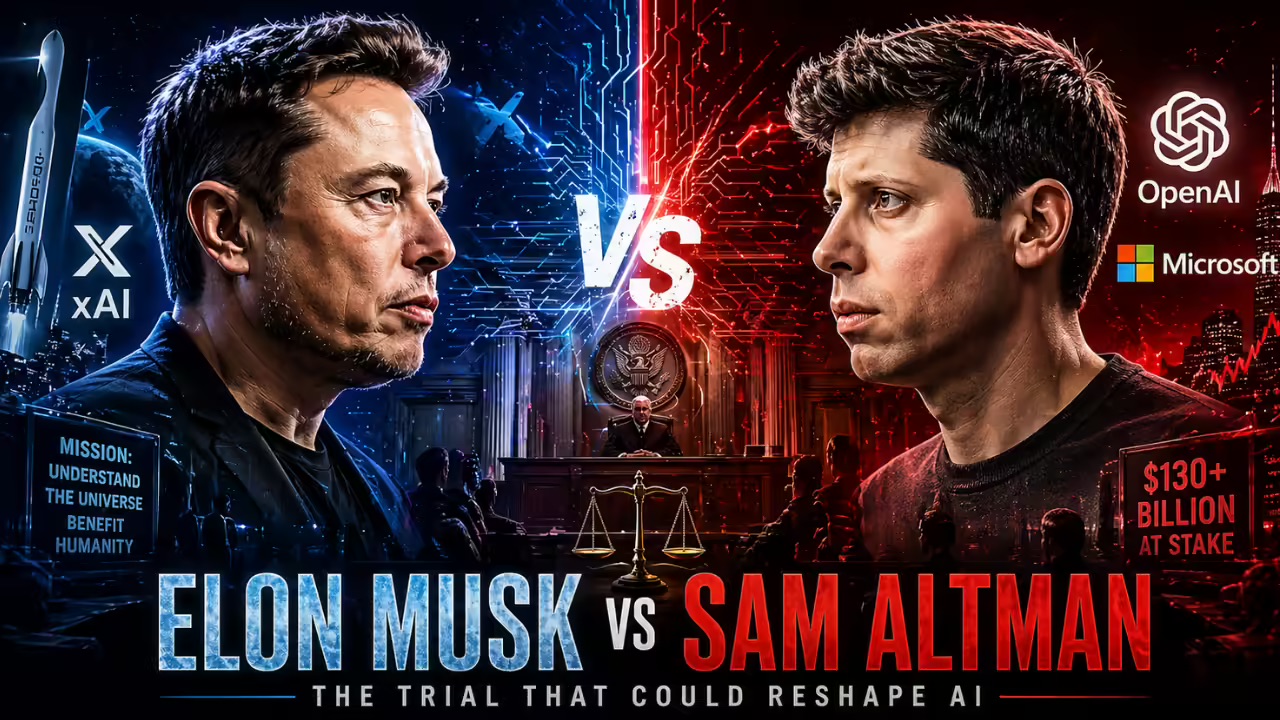
Tensions between tech titans reached a boiling point today as Elon Musk and Sam Altman entered a California courtroom for the start of what could become one of the most consequential trials in the history of artificial intelligence. Musk, one of OpenAI’s original cofounders, is suing Altman and OpenAI for allegedly abandoning the organization’s founding mission to develop AI technologies for the benefit of humanity. He claims that the company shifted its focus toward profit maximization via its lucrative partnership with Microsoft and recent forays into IPO rumors.
The high-stakes case, filed in early 2024 and now heading to a jury trial, seeks to remove Altman and cofounder Greg Brockman from OpenAI’s leadership. Musk has also demanded a cessation of OpenAI’s public benefit corporation (PBC) model and the potential payout of up to $150 billion in damages to OpenAI’s nonprofit counterpart. As both Musk’s xAI and OpenAI race to dominate the increasingly competitive AI landscape, the trial could have far-reaching implications for the future of AI governance and corporate influence.
Musk’s Accusations: Betrayal and Profit-Driven Governance
Musk’s legal filing portrays him as a whistleblower who helped lay the foundation for OpenAI in 2015 on a promise that the organization would steer artificial intelligence development toward global benefit. But according to Musk, Altman and Brockman orchestrated a bait-and-switch, converting OpenAI into a hybrid for-profit/Public Benefit Corporation (PBC) model in 2019, allegedly failing to alert stakeholders of the massive structural change. This pivot, Musk argues, paved the way for billion-dollar partnerships like OpenAI’s exclusive cloud computing deal with Microsoft and the eventual launch of ChatGPT, a commercial blockbuster.
“Altman and Brockman manipulated me into funding the early stages of OpenAI’s creation under false pretenses,” Musk’s lawsuit alleges, describing the company’s evolution into a for-profit entity as a betrayal of the original vision. He claims he was tricked into committing significant resources — financial, intellectual, and reputational — that were later leveraged for private gain. Newly surfaced emails, cited by Musk’s legal team, reveal his objections back in 2016 to OpenAI’s close ties with Microsoft, a platform Musk reportedly referred to as making him feel “nauseous.”
Musk is now seeking sweeping structural changes at OpenAI, as well as damages he argues are owed to OpenAI’s nonprofit entity. Though critics call his case a self-serving maneuver designed to derail a competitor and promote his competing xAI initiative, Musk insists his goal is accountability and realignment with OpenAI’s original mission.
OpenAI’s Defense: Musk’s Lawsuit Is “Baseless”
OpenAI has called Musk’s claims “a baseless and jealous bid to derail a competitor,” pointing to Musk’s concurrent investments in AI ventures such as xAI and his chatbot, Grok. Altman has argued that OpenAI’s reorganization in 2019 was done transparently and out of necessity. According to court filings, the switch to a PBC allowed OpenAI to attract critical funding, including Microsoft’s injection of infrastructure support worth $1 billion, which underpinned the technical breakthrough seen in models like GPT-3 and GPT-4.
“Without the restructuring, OpenAI couldn’t have scaled to meet the challenges of developing and responsibly deploying advanced AI,” OpenAI said in a statement. This defense hinges on the idea that OpenAI is still operationally and philosophically aligned with its founding mission — just better funded. The company maintains its dual commitments to maximizing shareholder returns and upholding its goal of AI safety, including initiatives focused on mitigating AI risks and engaging policymakers like the White House and European regulators.
Altman’s critics, however, argue that the monetization of AI via products like ChatGPT has created an ecosystem prioritizing quarterly earnings over transparency or ethical AI development. These concerns have emerged against a backdrop of unease about AI’s sweeping societal impacts, from job displacement to misinformation on a global scale.
Broader Industry Stakes: An AI Turf War
The Musk vs. Altman courtroom battle isn’t happening in a vacuum — it comes at a time of fierce competition and consolidation across the AI industry, worth hundreds of billions of dollars. Musk’s xAI, incorporated in 2023 with the stated goal of building “truth-seeking” AI, has introduced Grok, its answer to OpenAI’s ChatGPT. This rivalry escalated last year when Musk also filed lawsuits against OpenAI and Apple, accusing them of monopolistic behavior after Apple integrated ChatGPT into its iOS ecosystem.
With Microsoft holding a dominant position as both OpenAI's partner and its exclusive cloud provider, rivals like Musk argue that the tech giant’s influence could lead to an overly consolidated AI market. Recent rumors about OpenAI considering an IPO to further expand its market position only amplify these competitive tensions. “Innovation in AI isn’t just a race for better technology — it’s a race to control the regulatory and economic parameters that will decide which players dominate this century,” said a source close to Musk’s legal team.
Legal and Financial Implications of the Verdict
Should Musk succeed, the trial could force a radical restructuring of OpenAI, potentially undoing the 2019 shift to a PBC model and jeopardizing investments from its key partner Microsoft. Musk has floated plans to revert the company to its nonprofit roots, but experts are skeptical of this scenario given the immensity of OpenAI’s assets and commercial dependencies. Failure on Musk’s part, however, would underscore the fragility of cofounder partnerships amidst the commercialization of groundbreaking technology. It could also strengthen Altman’s leadership position as he navigates AI expansion into new verticals, ranging from enterprise solutions to national defense.
Given that xAI is rumored to be exploring its own public offering later this year, and OpenAI is eyeing the same, the trial could be interpreted less as a dispute over governance and more as a power play over AI dominance. With jury selection beginning today and opening arguments expected to stretch into early May, all eyes in Silicon Valley are on Northern California for what could be both a reckoning and a recalibration for AI’s future direction.
The Road Ahead for AI Governance
Regardless of the trial’s outcome, this legal battle is emblematic of deeper questions confronting the AI industry: How should society balance AI’s disruptive potential with ethical constraints? OpenAI’s rapid evolution, from a nonprofit to one of the most valuable players in AI innovation, could be a template — or a cautionary tale — for the next generation of startups. If nothing else, the trial highlights the volatility at the intersection of profit incentives, technological ambition, and moral responsibility.
Looking forward, the verdict will likely influence not just OpenAI’s trajectory but also how regulators, investors, and technologists think about aligning AI advancements with the public good. As competitors like Google’s DeepMind, Anthropic, and Musk’s xAI continue building their own systems, the responsible deployment of artificial intelligence could emerge as an essential battleground for companies and governments alike.