
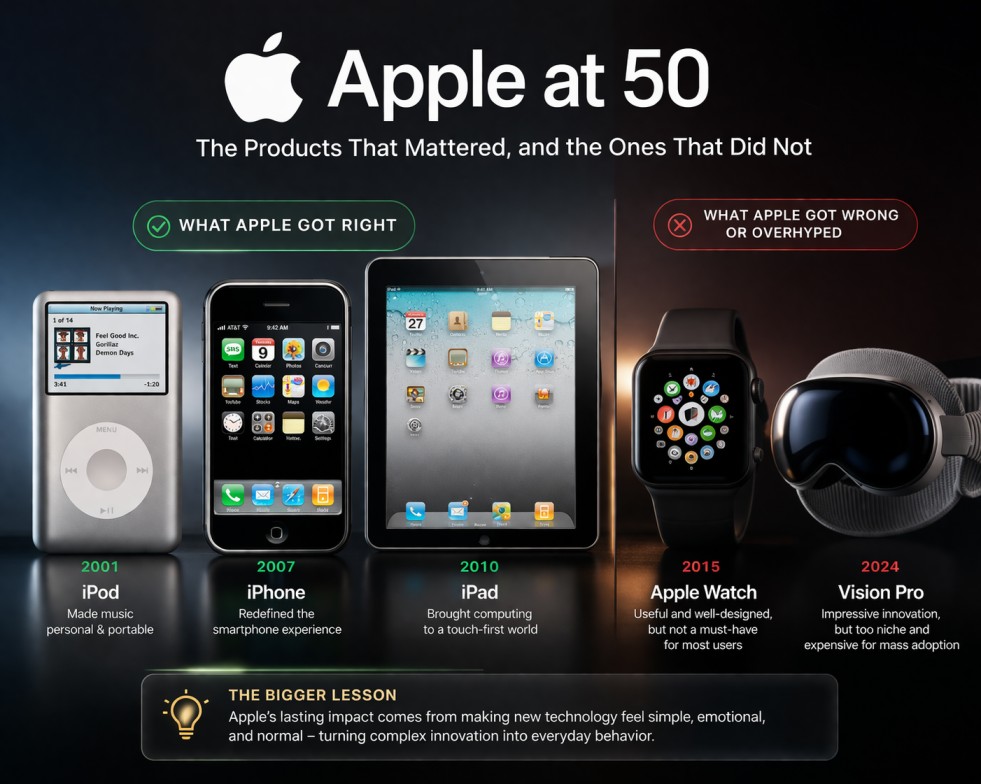
When a company reaches a milestone like 50 years, it’s easy to turn the story into a highlight reel. But the real story of Apple isn’t just about what it built—it’s about what actually changed how people live and use technology.
What Apple Got Right
Apple’s biggest successes were never just about powerful hardware or impressive specifications. They were about making technology feel simple, intuitive, and desirable.
Products like the iPod, iPhone, and iPad didn’t just sell well—they reshaped behavior. They turned complex digital interactions into everyday habits. Music became portable and effortless. Communication became constant. Computing became touch-driven and personal.
That’s the difference between a successful product and a defining one: people don’t just use it—they rely on it.
What Apple Got Wrong (or Overhyped)
Not every Apple product reached that level. Some launches generated hype but didn’t become essential in people’s lives.
These products weren’t necessarily failures—they often pushed design forward or explored new ideas. But they didn’t create lasting behavior change. They remained niche, experimental, or transitional.
And that’s an important reminder: even the most successful companies make bets that don’t fully land.
Why Some Products Last
Looking at Apple’s biggest wins, a clear pattern emerges:
They solved real, everyday problems
They felt obvious once introduced
They fit seamlessly into a larger ecosystem
This combination is rare. Many companies copy the look of Apple’s products, but miss the deeper integration and user experience that actually drives adoption.
The Bigger Lesson
Apple’s greatest contribution isn’t just individual products—it’s a shift in how we think about technology.
Success isn’t purely technical. It’s emotional.
The products that win are the ones that make new behavior feel natural. Not forced. Not complicated. Just… normal.
And that’s why, even after 50 years, Apple’s biggest impact isn’t what it built—it’s how it changed expectations.